Community History
Communal Life:
The town of Bloemhof, located in the Transvaal, sits on the banks of the Vaal River. It was established in August 1864, following the discovery of diamonds in the area. Notably, Bloemhof predates Kimberley, which was founded in 1871, and the local diamond discovery even occurred before the Hopetown diamond discovery of 1866. It is reasonable to assume that Jews were among the early inhabitants of the town, although we know very little about Jewish life during that period.
The Bloemhof Hebrew Congregation was officially established in 1918. A synagogue was built, and a plot of land was secured for a cemetery. The synagogue was located on Erf 182 at the corner of Evans and Malherbe Streets and officially opened in 1918. Given that it likely took several years for the community to form and for the need for communal infrastructure to be expressed, advocated for, and ultimately funded, we can assume that High Holiday services were held in a local hotel or at the nearby Freemasons Hall, as was common in small towns.
The Bloemhof Hebrew Congregation was officially established in 1918. A synagogue was built, and a plot of land was secured for a cemetery. The synagogue was located on Erf 182 at the corner of Evans and Malherbe Streets and officially opened that same year. Considering that it likely took several years for the community to form and for the need for communal infrastructure to be articulated, advocated for, and ultimately funded, we can assume that High Holiday services were held in a local hotel or at the nearby Freemasons Hall, which was typical in small towns.
1) Reverend Burbaitzky (the family was from Savlan/Siaulenai, Lithuania).
2) Reverend A Sidler (presumably Alter Sidler. He and his wife Alte Sidler, who passed away in 1936 were from Ponvez. Reverend Alter Sidler remarried in 1951 and was listed as a Rabbi).
3) Reverend Moshe Katz, I think Moses Katz who passed in 1965, as he is listed as a retired Minister on his death certificate.
4) Hirsch Leiman (1861-1943).
4) Reverend LM Spak.
5) Reverend Israel Segal or Siegel. Reverend Siegel passed away in Kimberley in 1945 and is buried in the West End Cemetery with his wife Gana Chieta.
Although there was no permanent minister after Reverend Segal, Victor Ressman, Mendel Altshuler's son-in-law, conducted services during the high holidays. Later, he also conducted services in Vryburg.
In 1950, members debated the synagogue's future. Some wanted to demolish it and build a room, while others preferred to close it and move the Sifrei Torah to a private house. There was also discussion about repairing the synagogue, and eventually it was decided to proceed with repairs. Members signed guarantees for the required amount, and the repairs were completed by Yom Tov 1950. In 1968, discussions about the synagogue's future resumed, and in 1971, the synagogue was demolished under slum clearance proceedings. The vacant stand, erf 182 Bloemhof, was eventually sold in 1974.
Commercial Pursuits:
A perusal of the Government Gazette's from 1919 - 1924, 1927, 1933 - 1951 and the various death certificates provides some insight into the commercial pursuits of the local Jews during these years. As we will see, the vast majority were general dealers/ store owners in the town itself and the wider district. Many of the places mentioned cannot be found on Google Maps and I assume they were on farms. The turnover in the earlier years is striking. Many dealerships changed ownership at a frenetic pace. This was especially the case from 1919-1924. This slowed down later. In part, it reflects the region's economic decline as other parts of the country flourished and Jews made their way to larger cities and towns like Klerksdorp and Potchefstroom. For some the stay in the district was as brief as a few months. Hence, they may well not be reflected in the databases constructed.
A few families made this town their long -term home.
Sadly, we have limited visibility into the community's economic activities before 1918. These were the heydays of the local Diamond Rush, when the community was probably at its demographic peak.
General Dealers from 1918 onwards:
Louis Guites was a general dealer (circa, 1918 and 1919 at Blesbokfontein - Bloemhof District and Killarney - Vryburg District). Other general dealers in these years were, Louis Dorfman (1921), Jacob Berkowitz (who later moved to Windsorton near Kimberley), Samuel Levitas (Bloemhof Cash Supply Store), Abraham Isaac Smukler (who also operated out of Wolmaransstad).
Louis Dorfman married May Carson, daughter of Joseph Carson. Carson was also a local general dealer and served on the founding Shul Committee. An A. Sandler sold his dealership to Max or Marks Berkowitz (1920). Berkowitz ended up settling at Witpoort /Boesmansrust near Wolmeranstad. We also have reference to Moses Cohen (1919), a Cohen (presumably Moses or Moses Isaac) and Kantor (presumably Solomon) in 1920. Solomon Kantor was in partnership with William Kirsh (who hailed from Grusd/ Gorzd). Solomon Kantor later sold his share to Noah Eides (1919).
Moses Cohen, Moses Isaac Cohen, Solomon Kantor, Jacobs Marks and William Kirsh were all on the Shul Committee in 1918. This would indicate that they were settled and economically established. Kirsh and Eides were still active together in 1921. At the time of his marriage to Jennie Spain (both from Kovno) in 1919, Eides is listed as residing in Bloemhof. Kirsh and Eides later become produce buyers.
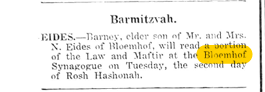
After Kirsh left for Potchefstroom Noah Eides stayed in Bloemhof. Eides maintained a long presence in the town and 1951 he and his son Barney were partners in an entity that wan engaged in the speculation of livestock and produce. In June 1920 Solomon Kantor applied to be naturalised whist residing in Bloemhof. By the time he married Dorothy Landau of Makwassie in 1926, he was living in Wolmaransstad and working as a Diamond buyer. Dorothy's father, David Mark Landau was a bookkeeper in Makwassie.
There are also notices that pertain to Marcel Levy (a French Jew) in 1919 and in 1922, at Leeufontein. At Leeufontein in the district, Levy partnered with Bernard Mathew Harris. The elder partner was born in 1895 in Newcastle, England Edward Harris (a German Jew) and Sarah Cowan. We have reference to a C.H. Bear (Dievedraai, 1919), W.G. Salmon (1919), Nechama Friedgood (1919), Daniel Gabbe (part of a Courland family which were communal stalwarts and served on the Shul Committee), J. Novick (London District, 1919), A. Segal (Hester Siding 1919), Segal and Hendler (1919 - Kameelkuil District), Fisher and Setzden (London District, 1919), J.D. Bauman (Kameelkuil, 1919), Isaac Haron (Pudumang, Schweizer Reineke) and Louis Miller (Kameelkuil - Bloemhof district and Schweizer Reineke - 1919).
Around this time, we also have Government Gazette notices thar pertain to Herman (Herze) Fabian and Harry Scheinberg (Zwartlaagte in the district -1920). Both were general dealers and both from Courland. Also active as general dealers in London District - Schweitzer Reincke were, Barnet Bolon, H.S. Marks and the Pick Brothers [Max and his bachelor brother Solomon] in 1921. Morris Selbst was active at Zeevenfontein in the Bloemhof district in 1922. By 1923 the Pick brothers were at Avonster. Solomon Pick was in London District as late as 1928. Barnet Julius Bolon applied to be naturalized in 1924 - still residing in Bloemhof.
In Bloemhof there was a store called Joseph and Joseph. I have yet to decipher their identity. One candidate was Max Joseph, a German Jew. Morris Sure, who passed away in Pretoria in 1927 was a local storekeeper and involved in communal life. Sure hailed from Dvinsk in Latvia. Judeiken and Company were in Schweizer Reinecke (1919). Ralph Lazarus (1919) had a butchery and a year later he was a general dealer. Julius Blumberg (who hailed from Talsen, Courland) married Ida Altshuler (daughter of Mendel) in Wolmaransstad in 1932 and left Hoopstad to be a general dealer in the area. In 1922 we find references to Jacob Heiman and his partner Barnett Alber, Bernard Matthew Harris and Marcel Levy (both discussed above), Moses Cohen (also already featured), Louis Bloch, Isaac Emanuel Sherman and Morris Slebst (from Dvinsk in Latvia). The year 1923 brings to light Julius Rosin, a produce dealer, Max Isaac Cohen (by now a veteran) and Gennie Berkovitz, Barney Robinson (Blesbokfoentein - who by 1929 was in Middelburg), Cecil Dennis and Chone Elias Gordon. Gordon married Annie Racussen from Port Elizabeth in 1923 and settled in Bloemhof, until he passed away in 1927. In 1923 Barnett Bolon was registered as a hawker (smous), Harry Scheinberg and Harry Fabian, who we discussed earlier, were now at Avondster. Another veteran, Max Farfel now had a general dealership at Kameelkol (Schweizer Reineke). There are announcements regarding Joel Levy and Paul (brother of Harry) Fabian, Jacob Berkovitz, Samuel and Michael Levitas, C. Zimmerman (Zevenfontein in 1924), E. Arons and D. Melvich (Kaalpan general dealership), Jacobs Marks (who owned Bloemhof Bargain, which shut in 1927), S. Stern and Morris Sure (now on Market Street). In 1924 the Government Gazette had notices pertaining to: Wides and Harris, C Zimmerman, Harry Schienberg (from Libau, who married out), Herman Fabian and his brother Paul Fabain and Joel Levy (who moved from Grootdorens to Hondvolop), Bernard Durbach (another Couland family), Barney Robinson (now a butcher), SF Berman (Zwartlagte), Joseph Sack (Grootdorens), Joseph Carson, who transferred his dealership to Louis Dorfman (his son-in law), Paul Fabian moved to Rooikraal, Barnett Albert moved to Blesbokfontein, C. Marks gave up three dealerships (Hondvolop-Bloemhof, Diamond Doors- Schweizer Reineke and Witgatboom -Christiana). In 1924 Max Isaac Cohen took ownership of a butchery, brothers Max and Solomon Pick were now at London (Schweitzer Reinecke), Michael Levitas and Max Weide were at Kaalpan. Michael Levitas also had a dealership at Zwartlaagte. That same year Michael Levitas (also trading at Zwartland) and his brother Samuel Levitas transferred their assets to a new business owned by the bothers and Max Weide). By 1927 the partnership between the three had dissolved. Max Weide moved to Durban and then Port Elizabeth after getting married. Samuel Levitas married an Afrikaans women (Maria Petronella Visagie) in 1931 and their daughter was baptised. Later, he re-married to a Jewish woman, Dora Fisher. He subsequently moved to Edenvale. Michael Levitas remained in Bloemhof. In the 1920s Max Farfel left a dealership at Grootdorns and Michael Harris Lawrence and M. Zimmerman took over Union Fruit Stores. Max Farfel (who hailed from Pandelys or Ponidel, Lithuania) was also listed as owning a store at Boschkuil West (Wolmaransstad) in 1928. In 1939 an A. Segal (Abraham) abandoned his business as tobacconist and local dealer. Abraham Segal was around as early as 1919.
In 1933 we also see the arrival of Israel Swil and Chaim Isaacs. Swill was in Bloemhof until at least 1946, when he married Fanny Esther Steyn of Middelburg. In 1935 Isaacs applied to be naturalized whilst living at Blesbokfontein. Also applying to be naturalized was Israel Davidson a general dealer at Amalia.
By the time of the Great Recession, the number of Jewish general dealers had drastically reduced.
Businesses in town:
Solomon Joseph Cohen sold his water manufacturing plan to Iedel (Edel) Herr and Phillip Herr in 1919. Benjamin Sarif (from Talsen, Courland) is listed as Salt Manufacturer at the time his marriage in 1937. Bottle store licenses were owned by Clara Rosenberg, Ellen Backenberg (not clear if she was Jewish) and Emily Cohen - the daughter of Herman Salinger and owner of the Bloemhof Hotel - was granted licenses from 1935 onwards for many years. Mendel Altschuler, the leader of the community, tried his hand at owning a general dealership. One was sold to Max Farfel in 1918, another at Kameelkuil in 1919 and then Kaalpan and Gansapn. He then owned a bottle store (1931) and later owned a butchery, which he gave up in 1943.
Herman Salinger also had a varied business life - working as a storekeeper and a hotelier. He owned the Bloemhof Hotel for several years. The local Cafe and Bioscope was run until 1927 by Samuel Rosin at 35 Prins Street. By 1933 Rosin was the owner of a hardware store and general merchants with a Willem Rosin (possibly related). There was a Max Fleischack who was a sworn appraiser in 1919 and later a lawyer. Heyman and Michael Benjamin Bolon took ownership of Bloemhof Motor Garage in 1920. In 1933 Michael Bolon transferred his share of OK Motors Garage and Produce Store to his partner, TP Glover. Mark Mintz owned the General Garage with A.E. Hawkey - the partnership was dissolved in 1924. Before that (1919), Mintz was a baker and general dealer. Max Julius Kowalsky secured a license to sell fireworks in 1927. In 1928 we see the tailor Abraham Isaac Smukler also features in the Government Gazette. Smukler later ran a business in Wolmeranstad. Joshua Friedman was registered as a hawker and Joseph Gross (1919 and 1924). Jeanotte Gabbe and Harry Judelsohn (1927) were travelling reps. Jeanotte Gabbe seems to have been quite industrious and in addition to being a rep, he was a shareholder in Bloemhof Cash Bazaar (1933) and a general dealer at Kareepan at the same time.
William Lewis was both a storekeeper and garage owner in Schweizer Reineke. The sense one gets is that Schweizer Reinecke and Bloemhof Jews were part of the same larger community. Michael Bentz, trading as Bentz and Company (1921) was a baker in Bloemhof. In 1924 we see CS Harris (in partnership with G. Scholtze) operating Zwartlaagte Bakery. Wulff Gabbe was a butcher in Wolmaransstad. Joseph Firestone was a Jeweller in Bloemhof. Maurice Israel was the local miller. He owned Bloemhof Milling - sold in 1935. Jerry Cooper was a local lawyer. In 1927 Cooper took on a partner in his practice, J. Margolis. In 1939 and 1940 MP Kirsh also worked as a local lawyer.
Farmers:
Michael Levitas (who we discussed above) started out as a general merchant and became a local farmer. Martin Springer also seems to to have been a farmer and general dealer at Kareeboom. Perhaps there were other general dealers in remote areas who were both traders and farmers. Bloemhof seems to have relatively few Jewish farmers. The only other farmers I came across were Harris and Abraham Plein, who farmed at Wildehondpan. They went bankrupt in 1924.
Diamonds:
Henry Albu was a diamond merchant, who passed away in a Durban Sanatorium in 1927. From his estate he appears to have been residing in Johannesburg, but still active in Bloemhof at the time of his passing. Charles August Billau, Vivian Randolph Aronson (born in Kimberley), Samuel Stone (1860-1953) and Samuel Abrahamson were also local diamond buyers. Arthur Steinhardt, Louis Katz and Samuel Samuels were diamond diggers. One assumes that diamonds were a reason why many Jews initially made their way to Bloemhof. I suspect that many of the Jews active in Bloemhof and it surrounds prior to 1918 were in the diamond mining and speculating trade.



Leeuwfontein - Wolmeranstad

The committee in 1926: Joseph Carson, Hyman Bolon, Julius Blumberg, Chone (Elias) Gordon, Michael Bolon, Barney Eides, Jankel Berkowitz, Louis Dorfman and Abraham Isaac Shmukler.


JH Bloch and D. Landau


1924


They were speculators in livestock and produce

